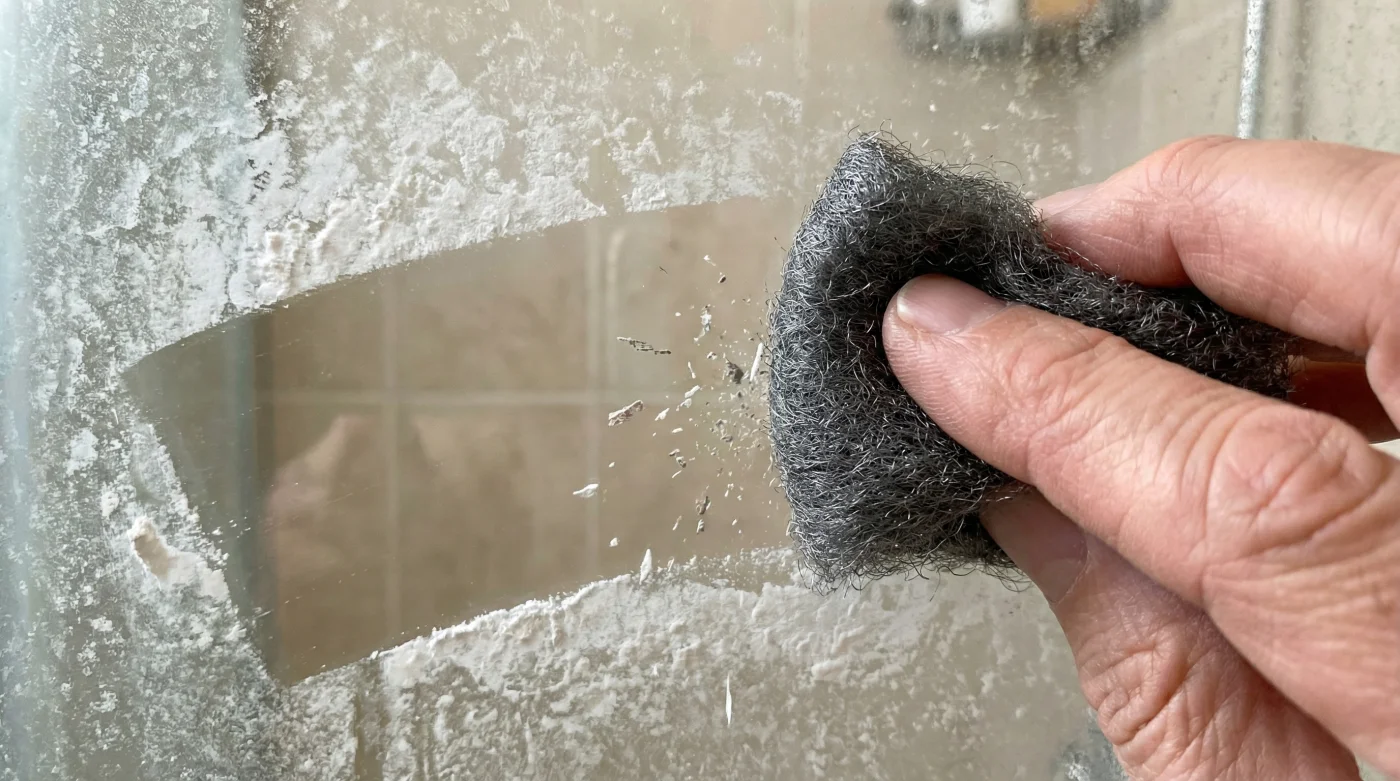
You step into the bathroom, hoping for a few minutes of quiet warmth, but instead, you are greeted by that familiar, milky haze. Your shower glass, once transparent and crisp, now breathes through a heavy crust of white spots. You know the smell of the harsh, eye-watering sprays that promise to melt the minerals away, yet only leave you choking in a confined space. You know the futile, squeaky drag of a sponge over those stubborn bumps. It feels permanent. You have likely resigned yourself to the idea that your tempered glass will forever look like a speckled curtain, holding onto years of hard water history.
The Illusion of Fragility and the Armor of Calcium
There is a persistent fear that taking anything metallic to glass is a recipe for disaster. We are taught to treat tempered panels with delicate, soft cloths, terrified of leaving a permanent etch that catches the light. But the buildup you are fighting—a stubborn matrix of calcium carbonate and magnesium—acts like armor. Soft sponges merely glide over it, compressing the moisture without removing the mineral. Heavy liquid chemicals often slide right off before they can penetrate the crust, landing uselessly on the shower floor.
| Your Frustration | The Specific Advantage |
|---|---|
| Renters with neglected bathrooms | Restores the property to baseline without buying expensive power tools or losing a security deposit. |
| Chemically sensitive individuals | Requires zero fumes, zero toxic sprays, and zero protective breathing gear. |
| Busy, exhausted homeowners | Takes minutes of physical effort per panel rather than hours of soaking, waiting, and scrubbing. |
A few years ago, I watched Marco, a veteran auto detailer in a hot Arizona garage, tackle windshields baked with years of harsh desert water. He did not reach for a gallon of acid wash or an aggressive power buffer. He grabbed a small, gray wad of metal. When I warned him he was going to ruin the customer’s windshield, he just laughed and tossed me a pad. “Glass is tough,” he told me, rubbing the metal across the window in tight, deliberate circles. “People think metal automatically scratches. But this is grade zero-zero-zero-zero. It only shears off what does not belong, leaving the foundation untouched.”
| Material | Mohs Hardness Rating | The Interaction Logic |
|---|---|---|
| Tempered Shower Glass | 5.5 to 7.0 | Hard enough to withstand ultra-fine friction without sustaining a single scratch. |
| Grade 0000 Steel Wool | 4.0 to 4.5 | Softer than the glass underneath, ensuring it acts as a gentle eraser, not a gouging tool. |
| Calcium Deposits | 3.0 | The softest layer in the equation. Easily pulverized and sheared off by the fine steel fibers. |
The Dry Polish Technique
The true secret to this physical modification contradicts your every cleaning instinct. You must use the steel wool completely dry. If you introduce water, heavy chemical sprays, or liquid soap, the delicate steel fibers will quickly oxidize, rust, and drag the minerals into a muddy, ineffective paste. You want the raw friction of dry metal against dry calcium.
Make sure your shower glass is fully dry before you begin. Take a fresh pad of grade 0000 steel wool—it will feel almost as soft as thick cotton—and press it flat against the glass. Work your hand in tight, firm circles. You will immediately feel a subtle, rough resistance, like rubbing sandpaper over a tiny mountain range of calcified peaks.
Keep rubbing steadily. Within seconds, that resistance will vanish entirely, replaced by a smooth, frictionless glide. That sudden physical shift is the exact moment the calcium deposit shears off the surface. As you move across the pane, a fine white dust will begin to fall away onto the floor. That dust is the enemy, finally defeated and detached from your glass.
- Dawn Powerwash spray instantly lifts set carpet stains without heavy scrubbing.
- Baking soda paste permanently etches delicate non-stick frying pans during scrubbing.
- Talc-free baby powder sweeps into floorboard cracks silencing squeaky wooden steps.
- Clorox bleach spray permanently yellows white fiberglass bathtubs after three uses.
- Uncooked white rice safely cleans inaccessible narrow glass vases completely overnight.
| What to Look For (The Quality Checklist) | What to Avoid Completely |
|---|---|
| Clearly labeled ‘Grade 0000’ or ‘Ultra-Fine’ on the package. | Grade 0, 1, 2, or 3 (These lower grades WILL permanently scratch your glass). |
| Plain, uncoated, and unsoaped steel fibers. | Kitchen scouring pads with built-in blue or pink soap mixtures. |
| A completely dry working surface and dry hands. | Spraying the pad with water or vinegar before touching the glass. |
A Clearer View of Your Sanctuary
There is something profoundly satisfying about fixing a physical frustration with your own hands, especially when it goes against what you thought you knew. By trusting the science of the materials rather than reaching for harsher, eye-watering chemicals, you reclaim control over your environment. The bathroom transforms back from a site of weekend chores into a place of rest.
When you finally step into that shower tomorrow morning, the space will feel physically larger. The overhead light cuts cleanly through the enclosure without catching on a thousand tiny, calcified blemishes. It is a small physical modification, taking only a few minutes of your time, but stripping away that cloudy barrier leaves you with a clearer start to your daily rhythm.
“The secret to true restoration isn’t applying more force; it’s understanding the unique nature of the materials right in front of you.” – Marco, Veteran Auto Detailer
Frequently Asked Questions
Is it absolutely guaranteed not to scratch my shower door?
Yes, provided you strictly use grade 0000 steel wool and your enclosure is made of standard tempered shower glass. Do not use this method on acrylic, fiberglass, or coated aftermarket plastics.Why can’t I use it wet or with a cleaning spray?
Using the pad wet reduces the necessary dry friction that shears off the hard water spots. Furthermore, moisture causes ultra-fine steel wool to rust almost instantly, which can leave orange stains on your tiles.How often should I perform this process?
Treat this as a deep-restoration technique to reset the glass every few months. For daily maintenance, stick to a simple rubber squeegee to prevent the water drops from baking on in the first place.Will this technique also remove heavy, waxy soap scum?
It easily removes the hard mineral bonds. However, heavy, greasy soap scum is often better handled by a basic glass cleaner after you shear off the rigid calcium shells that protect it.Can I use the exact same pad for the whole shower enclosure?
A single pad will usually handle one or two large panels before the delicate fibers flatten out and lose their cutting edge. Switch to a fresh pad when you notice it feeling less effective or overly smooth.