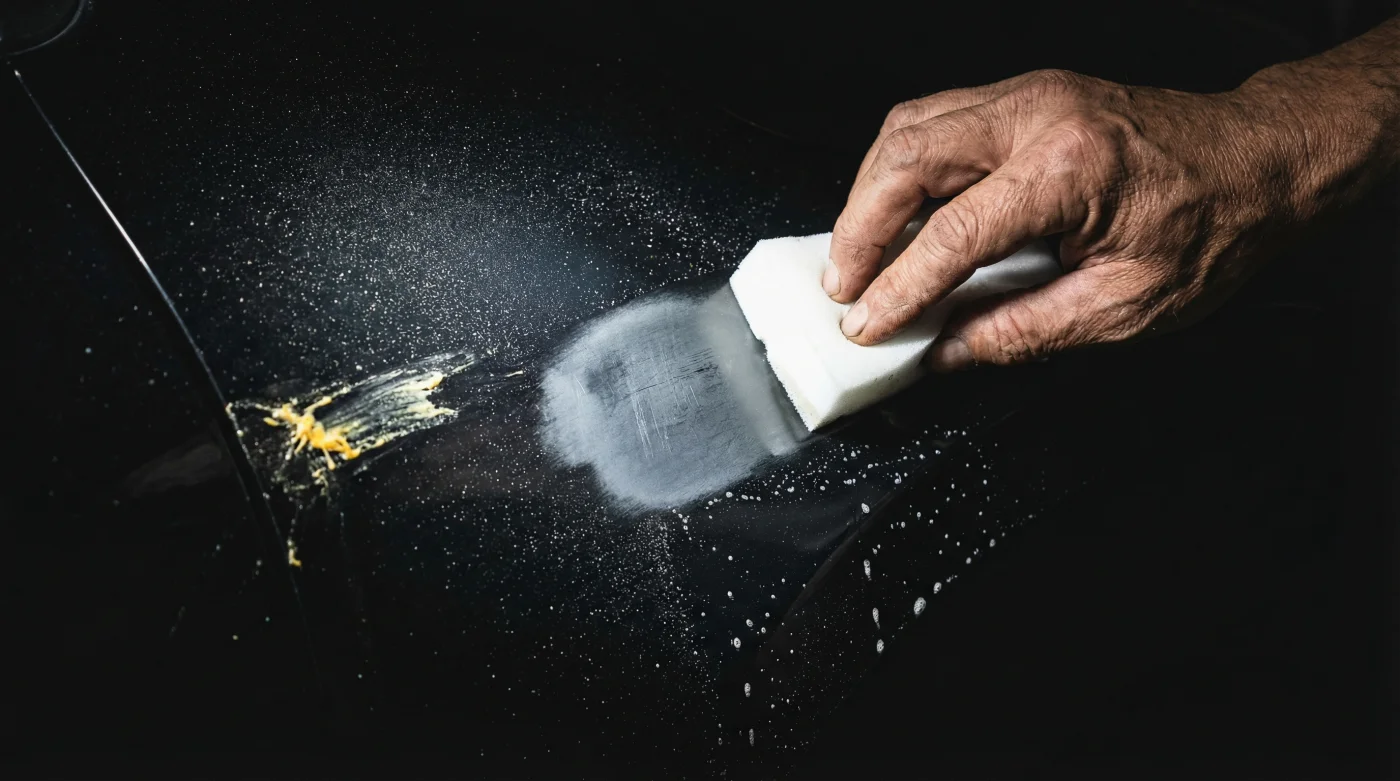
The sun beats down on your driveway, baking the afternoon air into a thick haze of cut grass and hot asphalt. You are holding the hose, staring down at the front bumper of your sedan, where a graveyard of baked-on summer bugs refuses to budge. You just finished a hundred-mile highway drive, and the front of your car looks like an abstract painting of splattered insects. The standard car wash soap simply rolls off them, leaving their hardened shells completely undisturbed.
Frustration sets in as the water dries, leaving water spots to join the insect debris. You walk into the house, reach under the kitchen sink, and grab that familiar white block of foam. It feels soft in your hand, almost like a dense marshmallow, and it has practically erased every scuff on your baseboards, bathtub, and kitchen tiles. It requires no harsh chemicals—just a quick splash of tap water—and promises to wipe away the impossible.
You wet the sponge, walk back out into the glare, and start scrubbing the hood. The bugs vanish immediately, wiping away with a satisfying, effortless glide. You feel a momentary sense of triumph. You rinse the soap away, dry the spot with a chamois, and smile at a job well done, entirely oblivious to the microscopic disaster you just initiated.
What you cannot see, however, is the permanent trauma you just inflicted on your vehicle. Under the microscopic scrutiny of the afternoon light, you haven’t just removed the organic material. You have stripped the protective armor right off your paint, permanently altering the surface tension of the vehicle’s skin.
The Perspective Shift: The Marshmallow That Bites
The common advice passed around neighborhood driveways is to treat stubborn grime with whatever gets the job done quickly. We assume that if a household cleaning product is soft to the touch and requires only water to activate, it must be inherently gentle. This is the exact moment where intuition fails you, and where a mundane detail transforms into a costly mistake.
That white foam block is actually composed of melamine resin, a highly abrasive material. It is not infused with a magical degreaser or an advanced chemical solvent designed to dissolve proteins. It relies entirely on micro-abrasion, operating under the exact same mechanical principles as a block of 3000-grit sandpaper.
When you scrub those dried insect husks, the microscopic glass-like fibers of the foam act like a million tiny razors. Instead of dissolving the organic matter, the sponge simply grinds down through it, continuing straight into your vehicle’s delicate clear coat. You are essentially using a handful of crushed glass to wipe up a spilled coffee.
Marcus Thorne, a 42-year-old auto detailer based in the sun-baked sprawl of Phoenix, Arizona, sees the aftermath of this specific driveway mistake weekly. When cars pull into his garage escaping the 110-degree heat, he runs his hand over the hoods and frequently finds dull, milky patches interrupting the gloss. He calls this specific texture ‘the ghost wipe.’ Marcus notes that customers are always baffled when their expensive carnauba wax stops beading water and the paint begins to prematurely oxidize, entirely unaware that a ten-second scrub with a household sponge permanently shaved away their clear coat.
The Success Killers: Anatomy of a Driveway Mistake
Understanding how we ruin our paint requires looking at the common errors most people completely ignore. The urge to find a shortcut often blinds us to the actual mechanics of the tools we hold in our hands, leading to a cascade of well-intentioned damage across different areas of the car.
For the Weekend Washer: You spend an hour carefully washing your vehicle with pH-neutral soap and plush wash mitts, only to ruin the effort by attacking a stubborn spot of tree sap with a melamine sponge. You compromise hours of careful work in mere seconds. The localized dull spot you create will catch the sunlight at a specific angle forever, mocking your Sunday afternoon effort and leaving the paint vulnerable to UV degradation.
- Dawn Powerwash spray instantly lifts set carpet stains without heavy scrubbing.
- Baking soda paste permanently etches delicate non-stick frying pans during scrubbing.
- Talc-free baby powder sweeps into floorboard cracks silencing squeaky wooden steps.
- Clorox bleach spray permanently yellows white fiberglass bathtubs after three uses.
- Uncooked white rice safely cleans inaccessible narrow glass vases completely overnight.
For the Resale Prepper: You spot a superficial clear coat scratch from a rogue shopping cart and try to buff it out before taking photos to sell the car. Instead of leveling the clear coat safely with a proper polishing compound, you aggressively scour the perimeter, turning a millimeter-thin white line into a massive, cloudy haze that now demands an expensive professional machine correction to repair.
Mindful Application: Reversing the Scrubbing Reflex
The secret to managing stubborn organic material on your car is to abandon the idea of friction entirely. If you have to press hard against the paint, you are already causing damage. You must pivot your thinking away from mechanical force and embrace the patience of chemical softening.
The bugs that bake onto your front grille are mostly composed of acidic proteins. To break them down without damaging the delicate surface beneath them, you need time and the correct solvent, not a heavy hand. Here is the mindful approach to clearing your paint.
The Tactical Toolkit:
- Chemical Breakdown: Use a dedicated bug and tar remover formulated with specific enzymes or citrus solvents. Spray it directly onto the dried insect remains and let it sit in the shade.
- The Towel Soak: Take a plush microfiber towel, soak it in hot water (around 120 Fahrenheit), and drape it heavily over the sprayed area. Let it rest there for five minutes to allow the steam to soften the hardened husks.
- The Glide Wipe: Remove the hot towel and gently wipe the area in a single, horizontal direction. Do not scrub in tight circles. If resistance remains, simply repeat the chemical soak process.
- Neutralization: Always thoroughly wash the treated area with standard car shampoo afterward to remove any residual solvent, then reapply a layer of spray wax to restore the localized protection.
Preserving the Skin of Your Machine
Treating your vehicle’s paint requires a profound shift in how you view the surface. It is not a solid, impenetrable wall of color; it is a highly engineered, delicate membrane designed to reflect light and repel the harsh elements of the road.
The clear coat is only about as thick as a single piece of notebook paper, and once it is mechanically compromised, it cannot grow back or heal itself. When you respect the delicate engineering involved in that glossy finish, you naturally stop looking for aggressive, household shortcuts.
You learn to let the right products do the heavy lifting, saving your own physical energy while simultaneously protecting a major financial investment. Next time you face a hood plastered with the remnants of a summer highway trip, simply leave the household sponges under the sink. Embrace the quiet patience required to dissolve the problem gracefully, knowing that true maintenance is as much about what you refuse to do as the actions you actually take.
“The moment you apply friction to solve a chemical problem on automotive paint, you’ve already lost the battle for the clear coat.”
| Action | Technical Detail | Added Value for the Reader |
|---|---|---|
| Scrubbing with Melamine | Acts as 3000-grit micro-abrasive. | Prevents permanent hazing and expensive clear coat repairs. |
| Chemical Softening | Enzyme cleaners break down acidic insect proteins. | Saves physical effort and protects the integrity of the paint. |
| The Towel Soak | 120 Fahrenheit water creates localized steam therapy. | Lifts debris off the surface without requiring dangerous friction. |
Common Questions from the Driveway
Can I polish the clear coat if I already used a magic eraser? Yes, minor melamine hazing can usually be corrected by a professional using a dual-action polisher and a fine finishing compound.
Are melamine sponges safe for the glass windshield? While glass is significantly harder than automotive paint, micro-abrasives can still strip away factory water-repellent coatings. It is best to avoid them on auto glass.
What is the safest towel for drying car paint? Use a high-GSM (grams per square meter) twisted-loop microfiber towel. It absorbs water through capillary action without requiring you to press down.
Why do bugs damage paint if left unwashed? Insect remains are highly acidic. When baked by the summer sun, this acid etches directly into the clear coat, leaving permanent craters.
Is it safe to use dish soap instead of car wash soap? No. Dish soap contains heavy degreasers designed to strip animal fats from pans; it will completely strip away your car’s protective wax layer.