You stand in your kitchen on a quiet Sunday morning, the warmth of a ceramic coffee mug grounding your hands, early sunlight pouring through the windowpanes. The bright light hits your glossy painted cabinets at exactly the right angle, revealing a stubborn, sticky smear of cooking grease lingering around the brass hardware. It is a minor visual disruption, the kind of small frustration that breaks the peaceful symmetry of a clean room.
Naturally, you reach beneath the sink for the familiar modern cure-all. You pull out that soft, unassuming white brick, dampening it under the faucet until it holds water like a marshmallow. The packaging promised miracles without chemicals, and for years, you have trusted this little block to erase scuffs from baseboards, revive dirty sneakers, and lift stains from countertops with zero real effort.
You gently wipe the cabinet door. The greasy smudge vanishes instantly, leaving behind a smooth, tight surface that feels almost squeaky clean beneath your thumb. You dry the spot off with a nearby towel, deeply satisfied with the immediate gratification, and seamlessly transition back into the rhythm of your morning routine.
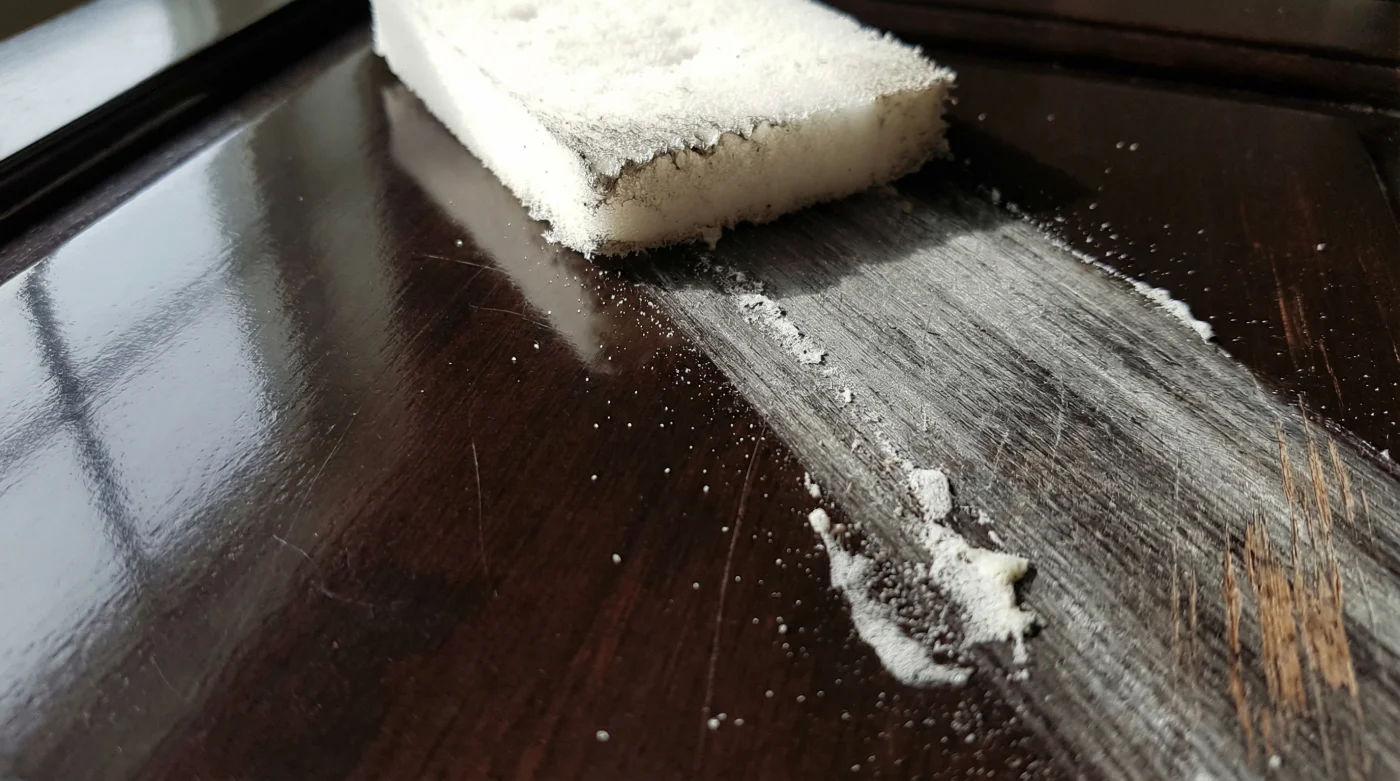
But later that afternoon, when the sun dips lower and casts long, creeping shadows across the room, you finally notice it. The gloss is completely gone. In its place sits a permanent, cloudy matte patch that catches the ambient light like frosted glass. No amount of rubbing, wiping, or expensive polishing oils will bring the shine back. You haven’t just cleaned the door; you have permanently altered its physical structure.
The Perspective Shift: The Sandpaper Disguised as a Cloud
To understand what went wrong, you have to completely stop thinking of this product as a sponge. A traditional kitchen sponge relies on a porous, forgiving texture and soapy water to lift debris safely away from a delicate surface. It acts as a soft vessel for chemical cleaning agents, explicitly designed to protect the material underneath from physical harm.
Melamine foam operates on an entirely different, highly aggressive principle. When you wet it, the material cures into a dense, rigid network of microscopic shards of glass, acting not as a gentle cleaner, but as an ultra-fine abrasive. It erases stubborn stains by physically scraping away the top layer of whatever it touches.
When you drag this foam block across your expensive wooden cabinetry, you are methodically grinding through the surface-level protective layers that keep the wood safe. You are applying microscopic sandpaper to a highly sensitive finish, carelessly stripping away the clear coat, dulling the factory gloss, and eventually chewing straight down to the raw paint.
The damage is incredibly insidious because it is so entirely invisible at first. You think you are simply wiping away a thin film of cooking oil, but you are actually excavating the factory finish. The grease is gone, yes, but only because the clear layer of cabinet finish holding the grease has been sanded completely off and washed down the drain.
Marcus Vance, a forty-eight-year-old custom cabinet restorer working out of a dusty, sunlit shop in Portland, Oregon, sees this exact tragedy play out every single week. “Clients bring in these gorgeous, five-thousand-dollar custom doors, completely devastated and panicked,” Marcus explains, tracing a rough finger over a ruined piece of mahogany. “They think they used a bad batch of dish soap. I run my hand over the dull spots and immediately feel the microscopic grit pattern. They scrubbed off three layers of baked-on enamel with a foam block because nobody told them it was basically 3000-grit sandpaper.”
Recognizing the Damage: How Specific Finishes Fail
Not all cabinetry reacts to abrasive damage the exact same way, and the degradation can look vastly different depending on your kitchen’s style. Recognizing how your specific finish degrades is crucial for stopping the habit before you inadvertently ruin the entire room’s layout.
For the High-Gloss Modernist
Acrylic and high-gloss painted surfaces are always the very first casualties. These specific finishes rely on a perfectly flat, mirror-like topcoat to bounce light uniformly back to your eye. Melamine instantly creates millions of microscopic trenches and jagged canyons in this fragile clear coat. Light hits these tiny trenches and scatters in a hundred directions, creating that hazy, heavily frosted look.
- Dawn Powerwash spray instantly lifts set carpet stains without heavy scrubbing.
- Baking soda paste permanently etches delicate non-stick frying pans during scrubbing.
- Talc-free baby powder sweeps into floorboard cracks silencing squeaky wooden steps.
- Clorox bleach spray permanently yellows white fiberglass bathtubs after three uses.
- Uncooked white rice safely cleans inaccessible narrow glass vases completely overnight.
For the Matte and Eggshell Enthusiast
Flat finishes hide the visual scratching slightly better under direct lighting, but they suffer a much faster textural death. The protective topcoat on matte painted cabinets is extremely thin by design. The foam easily chews straight through it in a matter of seconds.
If you run your hand over the spot, you will notice the area feels slightly chalky and porous to the touch. The very next time you try to wipe away a tomato sauce spill in that exact spot, the acidic liquid will soak directly into the wood fiber, swelling the door from the inside out and causing the paint to bubble.
Mindful Application: The Reversal Protocol
You simply do not need abrasives to maintain a pristine, beautiful kitchen. You just need to respect the basic chemistry of household grease and the physical vulnerability of your finishes. Transitioning to a safe cleaning routine requires a slight adjustment in your patience, but the longevity of your cabinets will absolutely thank you for the effort.
The secret lies in methodically breaking down the molecular bonds of kitchen grease rather than attempting to tear the grease off with brute physical force. You want to emulsify the oils so they lift away without putting up a fight.
Build yourself a minimalist, highly effective, non-destructive cleaning kit.
- The Medium: Keep a stack of high-quality, split-pile microfiber cloths. These grab dirt physically through static and surface area without scratching the clear coat.
- The Solvent: Rely on a few simple drops of standard, degreasing dish soap. Forget heavy-duty commercial sprays; dish soap is formulated specifically to melt food grease safely.
- The Temperature: Use water heated to exactly 105°F to 115°F. Warm water massively accelerates the emulsification of fats.
- The Motion: Always wipe with flat, open palms. Never dig your fingertips into the cloth to scrub a localized spot, as this creates uneven pressure points.
When you encounter a heavily hardened splash of pasta sauce or stubbornly sticky oil, do not immediately start scrubbing. Press a warm, soapy microfiber cloth firmly against the spot and hold it there, breathing steadily, for thirty seconds. Let the gentle heat and the soap do the heavy lifting. When you finally pull the cloth away, the debris will simply slide off.
Honoring the Foundation of Your Home
Taking a purposeful step back from the instant gratification of abrasive scrubbing forces you to interact with your living space much more thoughtfully. Your kitchen cabinets are not just functional storage boxes; they are the architectural anchor of your daily life, heavily finished by craftsmen to withstand decades of gentle, appropriate use.
When you finally understand that a shiny white block of foam is actually a mechanical weapon, you stop fighting against the delicate materials in your home. You begin to treat the wood and paint with the respect they command. Let the kitchen age gracefully. Preserve the invisible protective layers that keep the heart of your home vibrant, and strictly reserve the sandpaper for the garage workbench where it belongs.
“The fastest way to clean a delicate surface is almost always the fastest way to destroy it.”
| Key Point | Detail | Added Value for the Reader |
|---|---|---|
| The Abrasive Truth | Melamine foam acts as microscopic sandpaper. | Prevents you from unknowingly ruining expensive paint finishes. |
| Visual Degradation | Creates cloudy, matte patches on high-gloss doors. | Helps you identify existing damage before it spreads. |
| The Safe Alternative | Warm water, dish soap, and microfiber cloths. | Provides a foolproof, non-destructive method for daily cleaning. |
Frequently Asked Questions
Can I polish the dull spot out of my cabinet?
If the clear coat is only lightly scratched, an automotive polishing compound might restore some shine, but deep melamine damage usually requires repainting.Is melamine safe for any kitchen surface?
It works beautifully on unsealed tile grout and bare glass oven doors, but keep it far away from anything painted, stained, or finished.Why doesn’t the packaging warn about cabinet damage?
Most boxes advise testing on an inconspicuous area first, but they rarely explicitly state the foam functions by sanding surfaces away.What if dish soap isn’t removing the heavy grease?
If soap fails, a heavily diluted solution of white vinegar can help cut through the fat, provided you wipe it away immediately with clean water to protect the paint.Will a magic eraser ruin stainless steel appliances?
Yes. It will permanently alter the factory brushed finish, leaving a chaotic, swirl-marked patch that cannot be repaired without professional refinishing.