You know the exact smell. That sharp, chalky, chemical odor of commercial silver polish that lingers on your hands long after you have scrubbed your knuckles raw. You pull that heavy, felt-lined wooden box out of the credenza, open the lid, and let out a long, heavy sigh. The heirloom forks, heavy soup spoons, and intricate serving knives passed down from your grandmother look like they survived a fire. They are coated in a stubborn, oily black tarnish. The holiday dinner is tomorrow, and the thought of spending three hours hunched over the kitchen sink, rubbing abrasive paste into delicate floral handles, feels like a tedious punishment. You want to honor your family’s history, but the sheer physical labor required to maintain these pieces forces you to keep them hidden in the dark.
We are told from a young age that maintaining beautiful things requires elbow grease. We accept the sore shoulders and blackened fingertips as the necessary toll for setting a beautiful table. But what if the way we approach tarnished silver is fundamentally flawed? What if you could erase decades of neglect in less time than it takes to brew a pot of coffee, without using a single drop of toxic paste?
The Alchemy of the Kitchen Sink
The core problem with traditional silver maintenance is our perspective. We treat tarnish like it is dirt, assuming we must scrub it away with sheer force and friction. But tarnish is not dirt at all. It is a quiet chemical marriage. Over the years, the silver reacts with trace amounts of sulfur in the air, creating a dark compound called silver sulfide. When you scrub away silver sulfide with a rag and an abrasive polish, you are not just removing the dark crust. You are actually scraping off microscopic layers of the precious silver itself. Over time, this aggressive friction wears down delicate engravings and exposes the base metals beneath silverplate. You are literally wiping away your inheritance.
I learned this vital distinction from Thomas, an antiquarian who runs a dusty, light-filled restoration shop off a brick alley in Savannah, Georgia. I once brought him a severely blackened silver tea service, apologizing profusely for its embarrassing state. He did not reach for a rag, a buffing wheel, or a tub of expensive pink paste. Instead, he walked into his small back room and pulled out a familiar blue-and-silver box of Reynolds wrap. I watched in mild confusion as he tore off a long, crinkling sheet. ‘You do not fight tarnish with friction,’ he told me, lining a plastic tub with the foil. ‘You just have to give the sulfur a better dance partner.’
| The Silver Owner | The Traditional Burden | The Foil Method Benefit |
|---|---|---|
| The Holiday Host | Sacrificing an entire evening to prep silverware before guests arrive. | Restores a full table setting in five minutes, saving hours of labor. |
| The Estate Inheritor | Watching delicate, antique family engravings slowly fade from abrasive polishing. | Preserves the absolute integrity of the metal by reversing the chemical reaction. |
| The Weekend Thrifter | Passing up beautiful, blackened yard sale utensils because they look ruined. | Instantly turns cheap, overlooked tarnished finds into gleaming dining treasures. |
Thomas explained that we can use basic household electrochemistry to reverse the damage. By combining aluminum foil, baking soda, and extremely hot water, you create a mild, temporary battery right in your sink. The scientific principle at play is an ion exchange. Sulfur actually prefers to bond with aluminum much more than it prefers to bond with silver. When you introduce baking soda and hot water as an electrical conductor, the sulfur breaks its bond with your heirloom utensils, travels through the hot water, and permanently attaches itself to the disposable aluminum foil. You are not removing the silver; you are convincing the tarnish to simply let go.
| The Ingredient | The Scientific Role | The Mechanical Action |
|---|---|---|
| Reynolds Aluminum Foil | The Sacrificial Anode | Possesses a higher affinity for sulfur, pulling the tarnish away from the silver. |
| Silver Sulfide (Tarnish) | The Cathode | Releases the trapped sulfur ions, reverting the dark crust back into pure, shining silver. |
| Baking Soda | The Electrolyte | Creates a highly conductive alkaline environment, allowing the electrical current to flow freely. |
| Boiling Water (212 Degrees) | The Catalyst | Provides the necessary thermal energy to accelerate the chemical reaction from months to mere seconds. |
The Water Bath Ritual
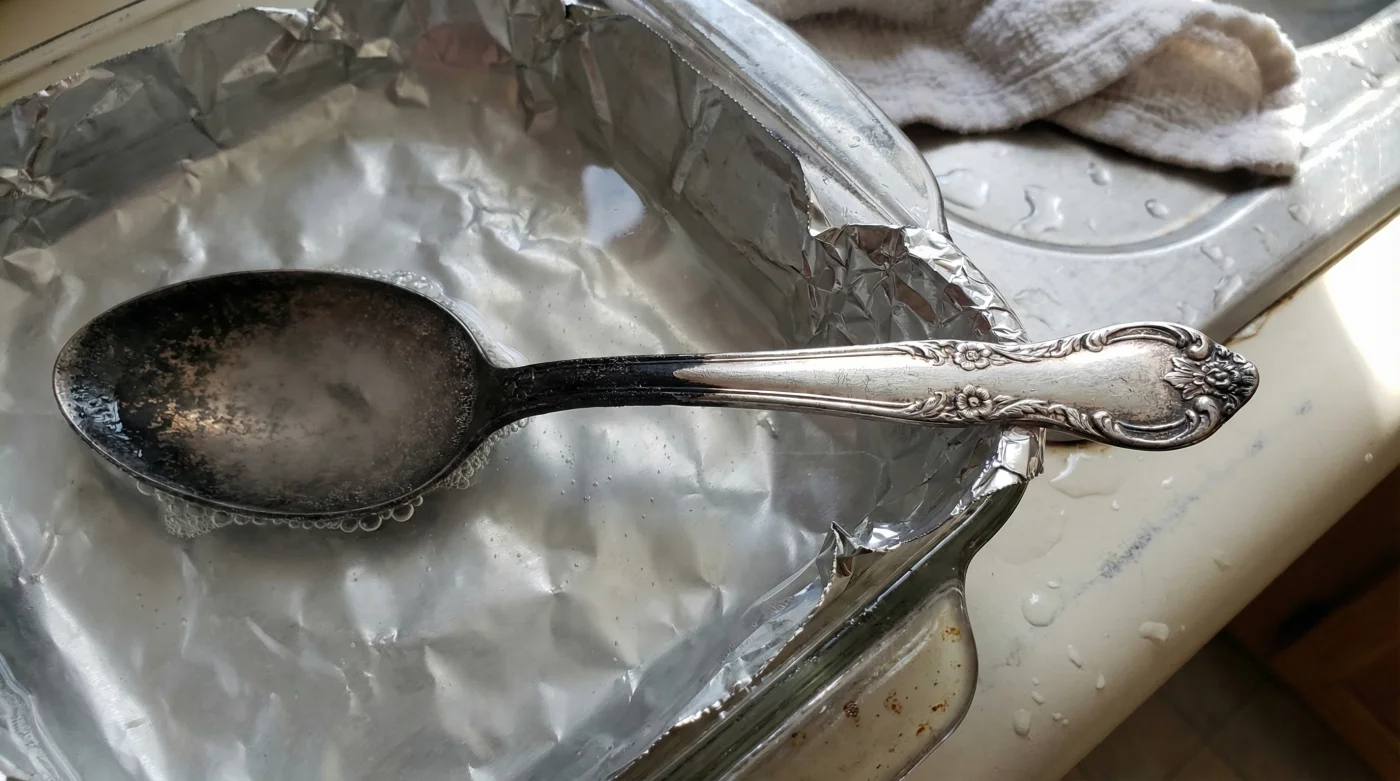
The beauty of this daily routine hack is entirely in its simplicity. To begin, find a glass casserole dish or an enamel roasting pan large enough to hold your utensils. Do not use a stainless steel or aluminum pot for the vessel itself, as the metals can confuse the electrical current. Tear off a large sheet of Reynolds aluminum foil and press it firmly into the bottom of the glass dish, keeping the shiny side facing up toward the ceiling.
Place your tarnished silver utensils directly onto the foil. This is the most crucial step of the entire routine: the silver must be making direct, physical contact with the aluminum foil for the battery to work. If you stack forks on top of other forks, the pieces on top will remain dark. Arrange them in a single, flat layer.
- Dawn Powerwash spray instantly lifts set carpet stains without heavy scrubbing.
- Baking soda paste permanently etches delicate non-stick frying pans during scrubbing.
- Talc-free baby powder sweeps into floorboard cracks silencing squeaky wooden steps.
- Clorox bleach spray permanently yellows white fiberglass bathtubs after three uses.
- Uncooked white rice safely cleans inaccessible narrow glass vases completely overnight.
Finally, carefully pour boiling hot water over the silver and baking soda. You will hear an immediate, deeply satisfying fizz as the water hits the powder. The liquid will bubble vigorously. Lean back slightly, as you will quickly notice the faint, distinct smell of rotten eggs rising from the steam. Do not panic. That odor is the sulfur physically leaving your family heirlooms and transferring to the foil. It is the smell of success.
| Application Element | What to Look For (Do This) | What to Avoid (Do Not Do This) |
|---|---|---|
| Water Temperature | A rapid, rolling boil. The extreme heat is what forcefully drives the ion transfer. | Lukewarm tap water. A cool bath will completely stall the reaction, leaving the silver black. |
| Foil Quality | A sturdy, high-quality wrap like Reynolds that resists tearing under heavy forks. | Flimsy dollar-store foils that shred into tiny pieces and fail to provide a solid conductive base. |
| Utensil Condition | Solid sterling silver or high-quality, thickly plated silver utensils and flatware. | Pieces with hollow handles, glued joints, or factory-applied artificial dark antiquing in the crevices. |
After just one to two minutes, use a pair of kitchen tongs to gently lift the utensils out of the bath. The heavy black grime will be entirely gone, replaced by a brilliant, mirrored shine. The aluminum foil at the bottom of the dish, however, will be stained with dark brown and black sulfur marks. Rinse your restored silver under warm running tap water to remove any lingering baking soda residue, and buff them dry with a soft cotton towel. The entire process takes less than five minutes.
Reclaiming Your Evenings
When we find smarter ways to manage our household routines, we are doing more than just saving time. We are removing the heavy friction that keeps us from enjoying the things we own. Inherited silver is meant to be used, held, and admired. It carries the weight of past family dinners, the clinking of toasts from decades gone by, and the warmth of a shared meal. When the maintenance cost is too high, we lock those memories away in a dark drawer. By trading harsh physical labor for a quiet, elegant chemical reaction, you invite these beautiful pieces back into your daily rhythm. You can finally set the holiday table with pride, knowing your hands are clean, your back is straight, and your evening is entirely your own.
“We are merely caretakers of these historic pieces; our true job is to preserve the integrity of the metal for the next generation, not scrub it away into an old, blackened rag.” — Thomas, Antiquarian Silversmith
Frequently Asked Questions
Does this trick damage or weaken the silver?
No. Unlike abrasive pastes that physically scratch off micro-layers of your precious metal, this method simply reverses a chemical reaction, leaving the pure silver entirely intact and unharmed.Can I use any brand of aluminum foil for this bath?
Yes, the chemistry works with any pure aluminum. However, Reynolds wrap offers a reliable, consistent thickness that holds up very well against the boiling water and the weight of heavy utensils without tearing apart in the dish.Why does my kitchen smell lightly of sulfur during this process?
That brief, sharp odor is hydrogen sulfide gas releasing as the sulfur forcibly breaks its bond with the silver and attaches to the aluminum foil. It is completely harmless in these small amounts and will dissipate quickly.Will this bath remove the dark shading in my detailed floral patterns?
Yes, the hot water bath reaches everywhere. If your specific silver pattern features intentional factory darkening—known as artificial patina—to highlight deep floral details, you should use this method very sparingly, as it will clean everything uniformly.How much baking soda do I actually need to make this work?
A reliable rule of thumb is roughly one cup of baking soda per gallon of boiling water. However, a generous, even dusting directly over the silver in a standard glass baking dish works beautifully every single time.